How to Stay Cool at Home Without Air Conditioning (2026 Guide)
The Short Answer
You beat indoor heat by fighting it on three fronts: keep heat out, move heat out, and cool your body directly. Close blinds and windows against the daytime sun, flush the house with a cross-breeze at night, stop generating heat indoors, and use water — showers, wet cloths, evaporation — to cool skin. Those tactics are free and they work. When you are ready to spend a little, skip the plain fan (it moves hot air without cooling it) and go to evaporative cooling, which genuinely lowers the temperature of the air around you for a fraction of what AC costs to run.
At 2 a.m. in a heat wave, everyone has the same thought: I can't live like this. The sheets are hot, the air is thick, and the fan on the dresser is doing nothing but stirring the soup. And for a growing number of households, the obvious answer — crank the AC — is off the table: either there is no AC to crank, the landlord will not allow a window unit, or the last electricity bill made running it all night feel like burning money.
The good news: your home is more controllable than it feels at 2 a.m. Heat obeys rules, and once you work with them instead of against them, most rooms can be made livable — often with tactics that cost nothing. Here are the eight that actually move the needle, roughly in the order you should deploy them.
1. Win the Window War: Block the Sun by Day
The single biggest source of daytime heat in most homes is free solar energy pouring through glass. A sunny window is effectively a radiator you did not ask for. So the first rule of a heat wave is counterintuitive: close everything while the sun is up. Windows shut, blinds down, curtains drawn — especially on the south- and west-facing sides.
Blackout curtains or thermal blinds are the upgrade here, but even a light-colored sheet hung over a hot window helps. If you can block the sun outside the glass — exterior shutters, an awning, even a strategically parked patio umbrella — better still, because the heat never gets inside at all. People who try this properly for one day are usually shocked at the difference by late afternoon.
2. Flush the Heat Out at Night
Sometime in the evening, the air outside drops below the air inside. That crossover is your signal to reverse everything: open windows on opposite sides of your home and let a cross-breeze flush the day's heat out. One open window barely helps — air needs an entry and an exit. Two openings on opposite walls, ideally with a fan pushing along the same direction, can swap the air in a room impressively fast.
The pro move: point a fan out of the hottest window, blowing hot indoor air outside, while cooler night air flows in through another opening. Exhausting heat is often more effective than blowing air in. Close it all up again before the sun gets to work in the morning, and you start the day several degrees ahead.
3. Stop Cooking Your Own House
In a heat wave, everything with a plug is a small heater. The oven is the obvious criminal — running it turns your kitchen tropical for hours — but the supporting cast adds up too: the dryer, the dishwasher on a hot cycle, the gaming PC, halogen bulbs, even the TV left on all day.
- Cook cold or cook outside. Salads, sandwiches, the grill on the balcony — anything that keeps the oven off until the evening cool-down.
- Run heat-producing appliances at night — dishwasher and laundry after the windows open, not at noon.
- Audit the standby heat. A room full of glowing electronics is measurably warmer than one without. Switch things off at the wall.
4. Use Fans Correctly (Most People Don't)
Here is the thing nobody tells you: a fan does not cool a room. It cools a person. Moving air speeds up the evaporation of sweat from your skin, which is your body's own cooling system. That is why a fan pointed at you feels wonderful and a fan oscillating at an empty corner accomplishes nothing but a light breeze on the furniture.
So: point the fan at people, not at the room. At night, position it so air moves across your bed. If you have a ceiling fan, set it to spin counterclockwise in summer so it pushes air down. And in the evening, remember tactic #2 — a fan in a window blowing out is a heat pump you already own.
5. Cool the Body, Not Just the Room
When the room refuses to cooperate, go straight for the thermostat that matters: you. Your body sheds heat through skin, and you can help it aggressively:
- Cold water on pulse points — wrists, neck, ankles — cools the blood passing close to the surface. Thirty seconds under the tap works absurdly well.
- A lukewarm (not ice-cold) shower before bed — it lowers your core temperature without triggering the rebound shivering that a freezing shower can.
- A damp cloth or chilled water bottle at the neck or feet while you sleep.
- Hydrate constantly. Sweating is your cooling system; it needs water to run. By the time you feel thirsty you are already behind.
6. Rethink the Bed
Beds store heat. Synthetic sheets, foam mattresses and heavy duvets hold on to everything your body radiates. In summer, switch to cotton or linen sheets, ditch the duvet for a light cover, and if your mattress sleeps hot, a breathable cotton topper helps more than you would expect. Sleeping lower helps too — heat stratifies, so the air near the floor is cooler than the air at loft height. People in heat-wave countries have slept on floor mats through worse summers than yours for centuries; they were onto something.
7. Humidity: The Hidden Multiplier
The number on the thermometer is only half the story — what your body feels is temperature plus humidity. Sticky air stops sweat from evaporating, which disables your built-in cooling. If your climate is humid, ventilate bathrooms and kitchens aggressively (steam is the enemy), dry laundry outside, and lean harder on airflow across the skin. If your climate is dry, you have been dealt a good card: dry air is exactly the condition where evaporative cooling — coming up next — performs at its absolute best, and a touch of added humidity is a comfort bonus rather than a problem.
8. The Smart Upgrade: Evaporative Cooling
Everything above is free, and you should do it all. But there is a ceiling on what blocking and airflow can achieve: none of it actually lowers the temperature of the air. The cheapest technology that does is one of the oldest: evaporative cooling — the reason a breeze coming off a lake feels cooler than the same breeze over a parking lot.
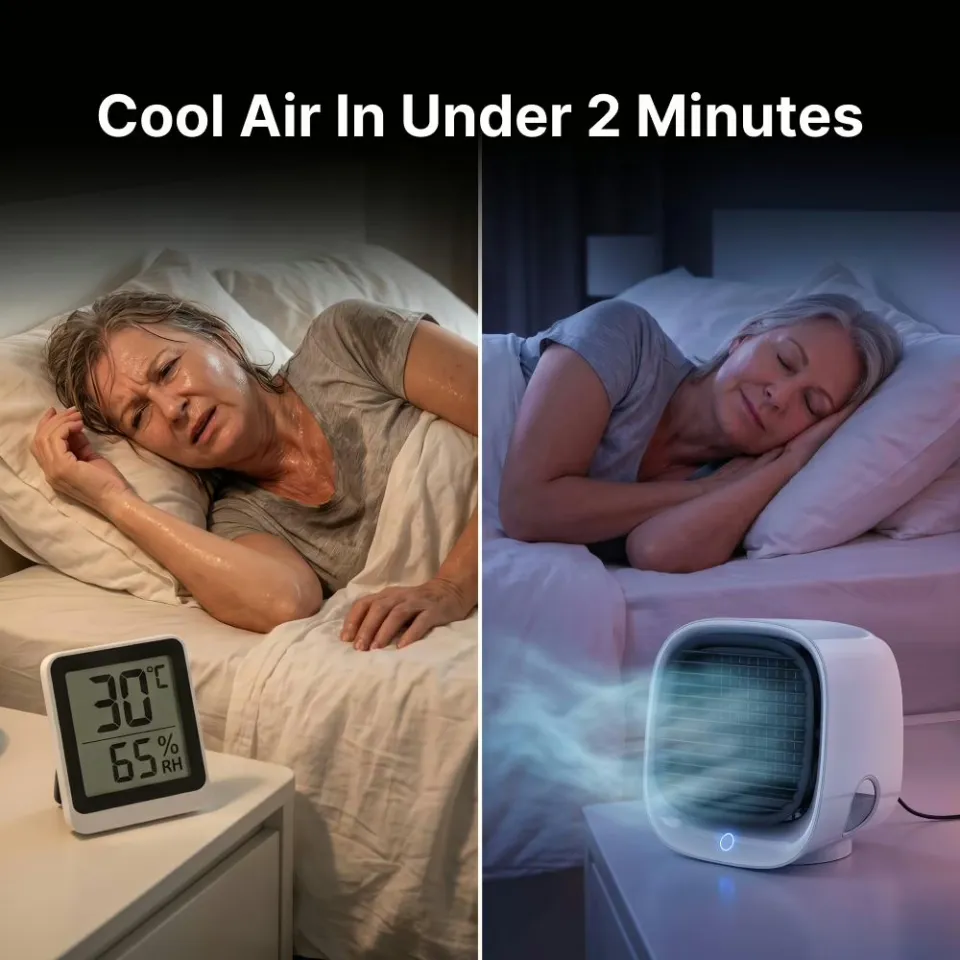
A modern portable evaporative cooler packages that physics into a box you can carry with one hand: a quiet fan pulls warm air through a water-soaked filter, the evaporating water absorbs heat, and the air comes out the other side genuinely cooler — not just moving. Because the only components drawing power are a small fan and a pump, running cost is a fraction of an air conditioner's compressor. And unlike a window AC unit, there is nothing to install: no exhaust hose, no window kit, no landlord conversation. Fill the tank, plug it in, done.
The honest frame: an evaporative cooler is a personal and small-room solution — the good ones are rated for spaces up to about 215 sq ft, which covers a bedroom, a home office or a dorm room. It will not chill an open-plan ground floor, and it is not a replacement for central AC where whole-house cooling is genuinely needed. But for the actual problem most people have — this room, right now, without an installation project or a scary bill — it is the smartest money in the category.
Frequently Asked Questions
How can I cool a room down fast without AC?
Work three fronts at once: block incoming sun (blinds and curtains closed on the sunny side), move air across your skin (fan pointed at you, not the ceiling), and cool your body directly (cold water on wrists, neck and feet). To actually lower the air temperature around you without installing anything, a portable evaporative cooler is the fastest budget option — cooler air within a couple of minutes.
Does a bowl of ice in front of a fan really work?
A little, briefly. It is a rough DIY version of evaporative cooling: air passes over melting ice and picks up some coolness, in a small area, until the ice is gone. A purpose-built evaporative cooler runs the same physics continuously from a water tank — hours instead of minutes, and a whole personal space instead of one spot.
Windows open or closed during a heat wave?
Closed by day, open by night. While outside air is hotter than inside air, open windows import heat — keep them shut with blinds drawn. Once the evening crossover comes, open opposite sides of the home and flush the heat out with a cross-breeze.
What's the cheapest way to actually cool the air?
Evaporative cooling. It genuinely lowers the temperature of the air passing through it while only powering a small fan and pump — a fraction of an air conditioner's draw. Good portable units cover spaces up to about 215 sq ft with zero installation, which makes them the practical budget upgrade for bedrooms, offices and rentals.
Why is my bedroom still hot at night with the window open?
Your walls and furniture spent all day storing heat and are now releasing it — bedrooms often peak just as you try to sleep. One window with no exit path barely moves air. Create a cross-breeze with two openings, exhaust hot air with a fan, and cool your sleeping zone directly instead of fighting the whole room.